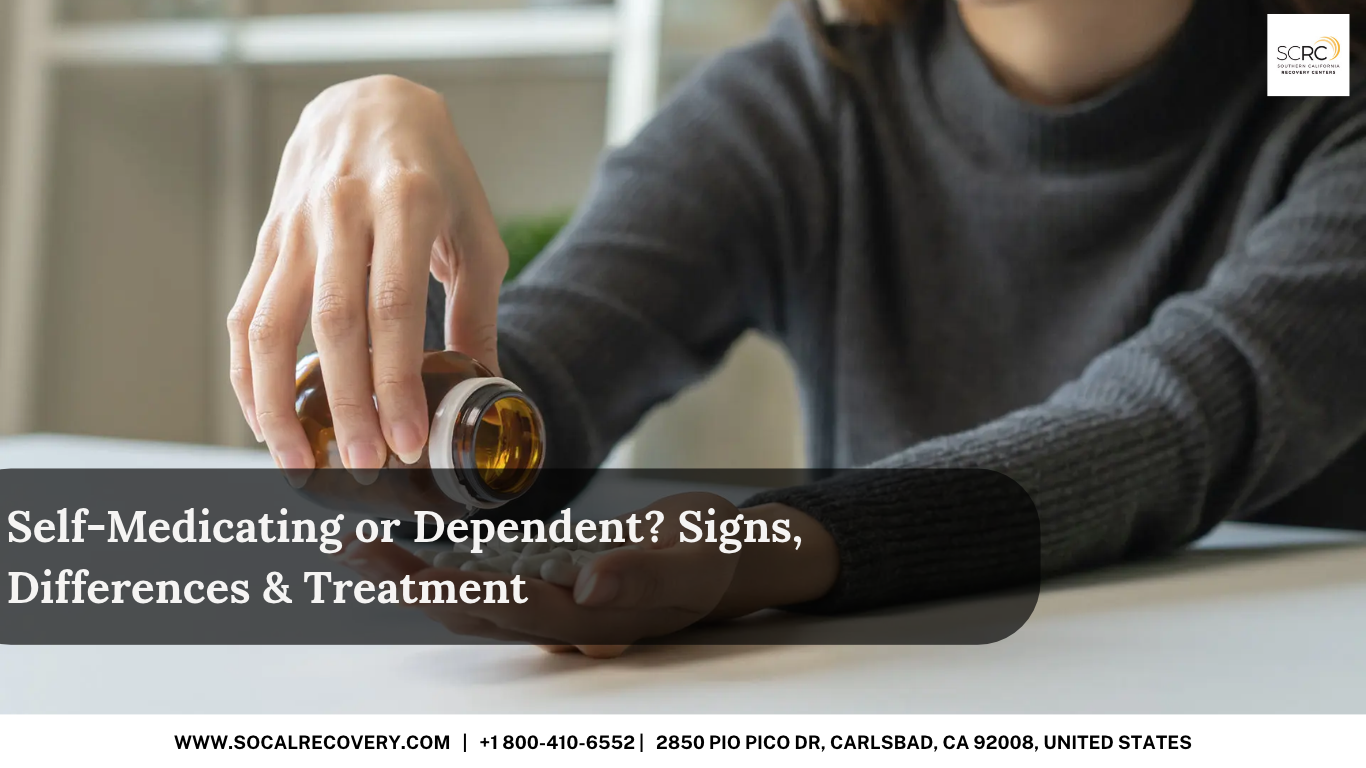
Self-medicating means using alcohol or drugs to quiet trauma symptoms. Dependence means your body and brain now need the substance and you cannot stop on your own. The line between them is blurry, and many service members cross it without noticing. That is why PTSD and substance abuse so often show up together.
The numbers help explain why. In Department of Defense surveys, about 20% of active-duty personnel reported heavy drinking, defined as binge drinking at least once a week. The same NIAAA review notes that many service members seeking treatment for alcohol problems also have PTSD, and many seeking PTSD treatment have alcohol or other substance problems.
This blog explains how to self-medicate from dependence, why active duty makes both harder to spot, and how treatment works at Southern California Recovery Centers (SCRC).
If you are a service member, or you serve beside one, and this sounds familiar, call SCRC at (800) 410-6552 for a free, confidential conversation. You can also read about our rehab for active duty military or verify your insurance, including TRICARE.
Key Takeaways
- Self-medicating is a coping move that can turn into dependence. The warning signs are tolerance, withdrawal, and loss of control.
- Trauma and addiction feed each other. Poor sleep, nightmares, and hyperarousal drive use, and use makes all three worse.
- Symptoms overlap. Anxiety, insomnia, and irritability can come from PTSD, from withdrawal, or both.
- You do not have to get sober first. Integrated care treats trauma and substance use at the same time.
- Active duty adds barriers. Stigma, career worries, and duty demands keep many people from asking for help.
- Treatment is confidential under HIPAA. Ask how your specific situation and chain of command are handled.
What Is the Link Between PTSD and Substance Abuse?
The link is usually self-medication: a person with PTSD uses a substance to dull symptoms that feel unbearable. The relief is real but short, and the cost builds over time. Research on service members supports this pattern, and the NIAAA review describes alcohol as a way to dampen the hyperarousal that comes with PTSD.
PTSD can leave the body stuck on high alert. People may notice:
- Nightmares and trouble sleeping
- Flashbacks or intrusive memories
- Feeling on edge, jumpy, or unsafe
- Numbness or feeling cut off from others
- Irritability and anger
- Avoiding reminders of what happened
Here is how substances often fit in:
| PTSD symptom | Substance often used | Why it seems to help | What happens over time |
| Insomnia, nightmares | Alcohol, sleep aids, benzodiazepines | Helps you fall asleep faster | Breaks up sleep and can bring more vivid dreams |
| Hyperarousal, anxiety | Alcohol, benzodiazepines | Calms the body for a few hours | Anxiety rebounds as the drug wears off |
| Intrusive memories | Alcohol, opioids, cannabis | Dulls the memory’s edge | Blocks the processing that heals trauma |
| Numbness, low mood | Stimulants, alcohol | Brings energy or a brief lift | Crashes deepen the low mood |
| Chronic pain after injury | Opioid pain medication | Eases physical and emotional pain | Tolerance and dependence can build |
Not everyone with PTSD develops a substance problem. The risk rises when a substance becomes the main way to cope.
How Do Trauma and Addiction Feed Each Other?
Trauma and addiction form a loop. Trauma symptoms push people toward substances, and substances make trauma symptoms and daily functioning worse. Without help, each problem keeps the other going.
The loop often runs like this:
- Trauma symptoms appear. Sleep falls apart, and the body stays on guard.
- A substance seems to help. One drink or pill takes the edge off.
- Tolerance builds. The same amount stops working, so use goes up.
- Withdrawal begins to mimic PTSD. Anxiety, insomnia, and irritability return between doses.
- Judgment and relationships suffer. Shame and stress grow.
- Trauma symptoms intensify. The cycle restarts at a higher level.
This is one reason the problem is hard to untangle. Many symptoms look identical whether they come from PTSD or from withdrawal. A trained team can sort them out, and you do not need to figure it out alone.
Self-Medicating or Dependent? How to Tell the Difference
You are likely self-medicating when you use a substance to manage trauma symptoms but can still choose to stop. You are likely dependent when you need more for the same effect, feel sick without it, or cannot cut back even when you want to. Here is how they compare:
| Self-medicating | Dependent (substance use disorder) | |
| Purpose | To cope with specific symptoms | To feel normal and avoid feeling sick |
| Control | You can usually skip a night | Attempts to cut back fail |
| Tolerance | Mild or none | Needing more for the same effect |
| Withdrawal | Rare | Shakes, sweats, anxiety, poor sleep without it |
| Daily life | Mostly intact | Work, relationships, or duty start to suffer |
| Risk | Rising | High, and often hidden |
When does it become a substance use disorder?
PTSD and substance use disorder can be diagnosed together when use causes real problems. Clinicians use 11 criteria. Two or three is mild, four or five is moderate, and six or more is severe. In plain language, ask yourself:
- Do I use more, or for longer, than I intended?
- Have I tried to cut down and failed?
- Do I crave it?
- Does it cause trouble with duty, family, or the law?
- Do I keep using it even though it makes things worse?
- Do I need more than before, or feel sick without it?
If you answer yes to even a couple, it is worth a conversation with a professional. If you drink heavily every day, do not stop suddenly on your own. Alcohol and benzodiazepine withdrawal can cause seizures, so medical detox is the safer route.
Why Does Active Duty Make This Harder to See and Treat?
Active duty hides the problem in several ways. Stigma, fear for your career, and constant demands keep many service members quiet. Drinking can also be part of unit culture, so heavy use may not look unusual to the people around you.
Common barriers include:
- Stigma. Asking for help can feel like weakness or a risk to your standing.
- Career worries. Many people fear what treatment will mean for their record.
- Duty demands. Deployments, training, and schedules make time away hard.
- Culture. Heavy drinking can be treated as normal.
- Not knowing where to turn. The system can feel confusing.
On confidentiality, SCRC follows HIPAA. Seeking help does not automatically lead to career consequences. Some situations, such as safety concerns or fitness-for-duty questions, can involve your command, so ask our admissions team how your case would be handled before you decide.
If you are in crisis, call or text 988 and press 1 for the Military and Veterans Crisis Line, or call 911.
Not sure how this applies to you? Contact our team or call (800) 410-6552.
How Are PTSD and Substance Use Disorder Treated Together?
The best approach is integrated treatment that works on trauma and substance use at the same time. The NIAAA review discusses treating alcohol problems and PTSD simultaneously, and treating only one often leaves the other in place. You do not have to be sober before trauma work begins.
At SCRC, an in-house clinical team provides care. Our active duty program includes:
- Trauma therapies, including EMDR, Seeking Safety, and Somatic Experiencing
- Individual and group therapy, with CBT and DBT
- Clinicians experienced in trauma-informed care and working with the military community
- Holistic support, such as mindfulness, yoga, and fitness training
- Family involvement, through family group sessions
- Aftercare, including support groups for military personnel and veterans
Here is how the stages often fit together:
| Stage | What happens | Learn more |
| Medical detox | Supervised withdrawal with 24/7 monitoring | Alcohol detox and drug detox |
| Inpatient rehab | Daily therapy, trauma work, and structure | Inpatient rehab |
| Step-down care | Outpatient or sober living while you practice skills | Alcohol treatment |
| Aftercare | Ongoing therapy, military support groups, and alumni | Alumni program |
Clients commonly stay for 30, 60, or 90 days, with longer care available. Our recovery timeline shows how the stages fit together. For opioid dependence that began with an injury, our prescription pills treatment page explains our approach.
How Do You Get Started, and Will Insurance Cover It?
Getting started takes one phone call. You talk with our admissions team, complete a confidential assessment, and learn what your insurance covers. Many plans cover treatment when it is medically necessary.
Here is how admission works at Southern California Recovery Centers:
- Call (800) 410-6552. The conversation is confidential.
- Complete an assessment. We look at your substance use, trauma history, sleep, and health.
- Verify your insurance. Our admissions staff works with insurers and can act as a liaison.
- Plan around your duties. We work with you on a plan that fits your service responsibilities.
- Begin treatment. Care starts with detox if you need it.
We have partnered with most insurance providers, including TRICARE, and also work with Aetna, Cigna, GEHA, UnitedHealthcare, and UMR. Coverage depends on your plan, so verify your insurance before you start. You can also read about our admissions process.
SCRC has served Southern California since 2012. Our locations are in Carlsbad and Cardiff by the Sea, and we welcome people from across North County San Diego, including Oceanside, home to Marine Corps Base Camp Pendleton, and Encinitas. If you are searching for rehab near me, you can view our Carlsbad location. We are accredited by the Joint Commission and certified by the California Department of Health Care Services.
No program can promise a specific outcome. Recovery depends on your history, your health, and your support. What a strong program can do is give you a safe, structured place to start.
How can family and fellow service members help?
- Describe what you see. “You have seemed on edge and drinking more since you got back” opens the door better than “You have a problem.”
- Listen first. Many people talk about sleep and nightmares before they talk about use.
- Avoid shame. Using to cope is common and treatable.
- Join family sessions. SCRC invites families to attend family group sessions.
- Know the crisis line. Call or text 988 and press 1 if someone is in danger.
- Look after yourself. Support matters for you too.
Ready to Break the Cycle? Call SCRC Today.
You do not have to keep fighting this alone. Call Southern California Recovery Centers at (800) 410-6552, or verify your insurance online. Our admissions team will listen, answer your questions, and help you choose a next step. You can also browse our Resources page for more guidance. Everything you share is confidential.
When Self-Medicating Becomes Dependence, Support Matters
Using alcohol or drugs to manage stress, trauma, or emotional distress can gradually become difficult to control. Southern California Recovery Centers provides structured addiction treatment and trauma-informed support for individuals facing substance use challenges and co-occurring mental health concerns. Speak with our team to understand your treatment options and take the next step toward recovery.
Get Confidential Help TodayFAQ's
Drinking is common after deployment, but common does not mean harmless. If you drink to sleep, calm down, or numb memories, or if you cannot stop, it may signal PTSD or the start of dependence. A professional assessment can tell you which.
You may be self-medicating if you use alcohol or drugs mainly to handle specific symptoms, such as nightmares, anxiety, or flashbacks. The warning sign is needing more over time or feeling sick or worse without it.
Yes, and it is common. Many service members and veterans seeking treatment for one condition have the other. Integrated treatment addresses both together.
No. Treating trauma and substance use at the same time is a recognized approach, and waiting until you are sober can leave the trauma untreated. If you drink heavily every day, start with medical detox for safety.
Seeking help does not automatically lead to negative consequences for your career. Your treatment is protected by HIPAA. Reporting rules for active duty can vary by situation, so ask our admissions team about your case.
Often, yes. SCRC works with most insurance providers, including TRICARE. Coverage depends on your plan and the level of care, so verify your insurance and our team will explain your options.
Yes. SCRC has locations in Carlsbad and Cardiff by the Sea and serves service members and veterans across North County San Diego. Call (800) 410-6552 to ask about availability.
Clients commonly stay for 30, 60, or 90 days, with longer care available. Your team sets the plan based on your needs and progress. Aftercare continues after the formal program ends.
They can feel almost identical: anxiety, poor sleep, irritability, and a racing heart. Withdrawal usually follows a drop in use and eases as the substance clears. A clinician can help sort out which is which.
Say what you have noticed, listen without judgment, and offer to make the first call together. Avoid ultimatums. If they talk about suicide, call or text 988 and press 1, or call 911.
You Served. You Deserve Care That Treats the Whole Story.
PTSD and substance abuse are tangled together, but they can be treated together. Understanding where self-medicating ends and dependence begins is a strong first step.
Call Southern California Recovery Centers at (800) 410-6552. Our team will listen, answer your questions, and help you take the next step.
Medical disclaimer: This article is for general education and does not replace advice from a licensed healthcare professional, and it cannot diagnose any condition. Do not stop drinking suddenly if you drink heavily, since withdrawal can be dangerous. If you are in crisis, call or text 988 (press 1 for the Military and Veterans Crisis Line). In a medical emergency, call 911.