
The high fades fast with cocaine, and the crash that follows can start within an hour. It doesn’t look like the comedown from most other drugs. There’s no gradual wind-down. Exhaustion and a sudden drop in mood arrive almost at once, and so does the pull to use again.
Knowing what’s coming next changes how that first crash feels. The cocaine withdrawal timeline follows a rough pattern, even though the pace differs from person to person, and having some sense of that pattern turns an unpredictable few weeks into something a little more manageable.
Below is a breakdown of each stage, the symptoms that tend to show up, what pushes the timeline longer or shorter, and why medical support during this stretch matters more than people expect going in.
Key Takeaways
- Cocaine withdrawal usually begins within hours of the last use, moving through four rough stages: crash, early withdrawal, acute withdrawal, and post-acute recovery
- The cocaine detox timeline varies, but most people are through the worst of it within one to three weeks
- The most common cocaine withdrawal symptoms are fatigue, depression, anxiety, cravings, disrupted sleep, and trouble focusing
- Cravings and low mood tend to stick around longer than any physical symptom, sometimes for months
- Medical supervision during detox lowers relapse risk, particularly during the depression-heavy stretch in weeks one through three
- Detox handles the physical reset. What actually keeps someone sober long-term happens afterward, in therapy and aftercare
Table of Contents
- Why Does Cocaine Withdrawal Happen in the First Place?
- What Are the Stages of the Cocaine Withdrawal Timeline?
- What Are the Most Common Cocaine Withdrawal Symptoms?
- What Affects How Long the Cocaine Detox Timeline Lasts?
- Why Does Medically Supervised Detox Matter?
- What Comes After Detox?
- FAQ
- Conclusion
Why Does Cocaine Withdrawal Happen in the First Place?
Cocaine forces the brain to release far more dopamine than it normally would, and withdrawal is what happens once that supply gets cut off. The brain has to figure out how to make dopamine on its own again, and it’s slow to catch up.
Regular use trains the brain to expect that surge. Once it stops coming, the shortfall is obvious almost immediately, and it shows up as exhaustion, flat mood, and a craving that can feel less like a preference and more like an alarm going off.
That’s part of why cocaine withdrawal reads differently than alcohol or opioid withdrawal. There’s rarely seizures or vomiting involved. What shows up instead sits mostly in the mind, which is exactly why it gets underestimated so often.
What Are the Stages of the Cocaine Withdrawal Timeline?
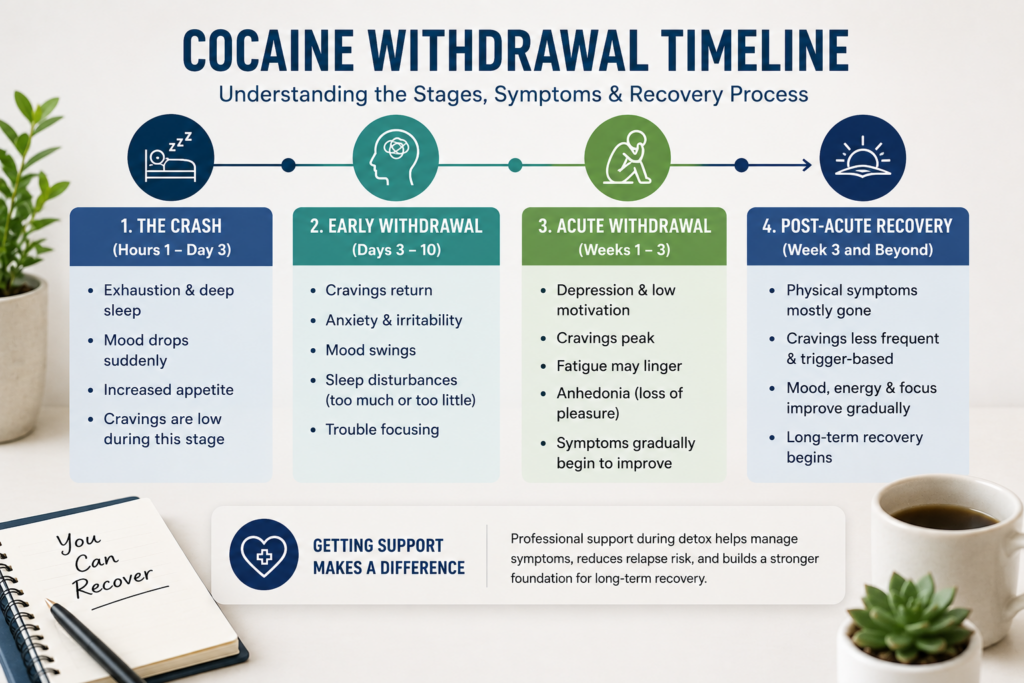
The cocaine withdrawal timeline breaks down into four general phases. Timing shifts based on the person, but the order rarely does.
The Crash: Hours 1 Through Day 3
This stage hits almost immediately. Sleep becomes the priority, sometimes twelve or more hours at a stretch, and mood drops sharply the moment the high wears off.
Appetite usually rebounds hard here too, since it’s often been suppressed for days leading up to this point. Cravings, oddly, tend to be low during the deepest part of the crash. The body is focused on rest, not on seeking more.
Early Withdrawal: Days 3 Through 10
Once the crash eases, the cravings come back, and they usually bring anxiety and a short temper along with them. This is often the stretch people describe as the hardest to push through mentally, even though it’s not the most physically demanding.
Sleep tends to swing to one extreme or the other, either too much or barely any. Concentration takes a hit too. Simple tasks, like following a conversation or finishing an email, start feeling harder than they should.
Acute Withdrawal: Weeks 1 Through 3
This is where the emotional weight of the process really lands. Depression settles in, motivation drops, and cravings often peak somewhere in this window before they start to ease.
A lot of people describe this stage as feeling flat, like nothing brings the same enjoyment it used to. Fatigue can linger here too, even once normal sleep patterns return. It’s frustrating, but it’s also expected, and it does pass.
Post-Acute Recovery: Week 3 and Beyond
Physical symptoms have mostly resolved by this point. What remains is psychological, and it can hang around for weeks or months longer than most people anticipate.
Cravings show up less often here, and they’re usually tied to a specific trigger rather than a constant pull. Mood and energy improve gradually. The brain’s ability to feel reward from ordinary things, work, relationships, hobbies, comes back slowly, not all at once.
What Are the Most Common Cocaine Withdrawal Symptoms?
Fatigue, depression, anxiety, intense cravings, disrupted sleep, irritability, and difficulty concentrating make up the bulk of what people experience. Here’s roughly when each one shows up and how long it tends to stick around.
| Symptom | When It Typically Shows Up | How Long It Usually Lasts |
| Fatigue | First 1 to 3 days | A few days, occasionally longer |
| Depression | Day 3 onward, peaks during acute phase | 1 to 3 weeks, sometimes beyond that |
| Anxiety | Starts in early withdrawal | 1 to 3 weeks |
| Intense cravings | Peaks in early to acute withdrawal | Weeks to months, coming in waves |
| Sleep disturbances | Runs through most stages | 1 to 4 weeks |
| Irritability | Early withdrawal | 1 to 2 weeks |
| Difficulty concentrating | Early through acute withdrawal | Several weeks |
| Mood changes | Present throughout | Weeks to months, improving gradually |
None of these are typically dangerous by themselves. What’s risky is the combination. Depression paired with a strong craving is the exact mix behind most early relapses, which is part of why this stretch deserves more attention than it usually gets.
What Affects How Long the Cocaine Detox Timeline Lasts?
There’s no single answer to how long the cocaine detox timeline runs. It depends on how much someone used, how often, and a handful of personal factors layered on top.
Someone who used heavily for years is going to have a rougher, longer post-acute stretch than someone who used less frequently over a shorter period. That’s the biggest driver. But it’s not the only one.
Existing mental health conditions matter too. Depression or anxiety that predates the cocaine use tends to intensify during withdrawal rather than sit quietly in the background. Using other substances alongside cocaine complicates things further and usually stretches the timeline out. General physical health, sleep habits, and nutrition going into detox all play a role as well.
Because every one of these factors interacts differently, a generic timeline only gets someone so far. Medical evaluation gives a far more accurate read on what to actually expect.
Why Does Medically Supervised Detox Matter?
The depression and craving intensity during cocaine withdrawal are the main reasons people relapse early, and medical supervision directly addresses both.
Cocaine withdrawal rarely needs hospitalization the way alcohol or opioid withdrawal sometimes does. The risk here isn’t a medical emergency in the traditional sense. It’s what depression, left unmonitored, can turn into, and how hard cravings are to outlast alone in an environment full of old triggers.
A supervised setting keeps a clinical eye on mood changes severe enough to need direct attention. It offers structure during the specific stretch when cravings hit hardest, medication support where it’s appropriate, and a physical distance from the people, places, or routines tied to using.
Families weighing options for a loved one often start by looking into a cocaine addiction treatment program california, since getting through detox in a structured environment gives someone a real shot at not relapsing halfway through.
What Comes After Detox?
Detox resets the body and gets someone past the worst of the physical and immediate psychological symptoms. It doesn’t touch the habits and patterns that led to using in the first place. That work starts once detox ends.
Behavioral therapy, particularly CBT, is usually where this begins, helping someone recognize the thought patterns that drive use before those patterns take over again. Individual and group counseling dig into whatever’s underneath the addiction, whether that’s trauma, an untreated mental health condition, or something else entirely.
Relapse prevention planning matters here too. Mapping out specific triggers and having a real plan for them beats hoping willpower carries someone through a hard week. Support groups, including 12-step models or other peer-based options, give people somewhere to go when things get difficult outside of formal treatment hours. Aftercare, often through sober living or continued outpatient support, keeps that structure in place once the most intensive phase ends.
Family involvement tends to strengthen all of this. Therapy sessions that include family members help rebuild the trust that addiction usually damages, and they give everyone a shared, realistic picture of what recovery actually takes going forward.
Programs across North County San Diego, including facilities in Carlsbad and Cardiff by the Sea, are built around this exact handoff, so detox flows straight into therapy instead of leaving someone to figure out early recovery on their own.
Get Professional Support for Cocaine Withdrawal and Recovery
Cocaine withdrawal can bring intense cravings, fatigue, anxiety, and emotional challenges that make recovery difficult without support. At Southern California Recovery Centers, we provide medically supervised detox, personalized treatment plans, evidence-based therapies, and ongoing aftercare to help you safely navigate withdrawal and build a strong foundation for lasting recovery. You don’t have to face this journey alone—our compassionate team is here to help every step of the way.
Start Your Recovery TodayFAQ
How long does cocaine withdrawal usually last?
Most people are through the acute symptoms within one to three weeks. Cravings and mood shifts can linger in a lighter form for months after that.
Is cocaine withdrawal dangerous?
Physically, it’s rarely as dangerous as alcohol withdrawal can be. The real risk sits with the depression and craving intensity, which in severe cases can include suicidal thoughts, so it’s not something to treat lightly.
What’s the hardest part of the cocaine withdrawal timeline?
For most people, it’s the acute withdrawal stage, roughly weeks one through three, since that’s when depression and cravings tend to hit their peak at the same time.
Can I detox from cocaine at home?
It’s possible, but not something we’d recommend without support. The depression and craving levels are genuinely easier to get through with someone monitoring how you’re doing day to day.
Do the cravings ever fully disappear?
They fade a lot over time, but occasional cravings tied to a specific trigger, a place, a person, a certain kind of stress, can resurface even well into recovery. That’s exactly why relapse prevention work doesn’t stop once detox ends.
How is cocaine detox different from opioid or alcohol detox?
It’s mostly psychological rather than physical. There’s less risk of a severe physical withdrawal, but a higher relative risk tied to depression and craving-driven relapse.
What treatment options exist near North County San Diego?
Detox, residential treatment, and outpatient programs are all available throughout the region, including in Carlsbad and Cardiff by the Sea, with the right level of care depending on how long and how heavily someone used.
Does insurance cover cocaine detox and treatment?
Many plans cover at least a portion. Coverage varies enough by provider that it’s worth having an admissions team walk through the specifics during a confidential assessment.
How soon after detox should treatment start?
As close to immediately as possible. The gap between finishing detox and starting real treatment is exactly when relapse risk is highest, so moving straight into the next phase matters.
What can family do to help during this process?
More than people usually expect. Staying involved, whether through family therapy or simply staying present and informed, tends to improve outcomes. Most treatment programs build family involvement into the process rather than leaving it optional.
This content has been reviewed for clinical accuracy. It’s intended for informational purposes and isn’t a substitute for a professional medical evaluation.
Conclusion
Cocaine withdrawal isn’t random, even though it can feel that way in the middle of it. The crash gives way to early withdrawal, which gives way to a harder acute stretch, and then to a slower climb back to normal that keeps improving with time.
Getting through the roughest part safely, especially the depression and cravings that hit hardest in those first few weeks, is a lot more doable with the right support in place. Call (800) 410-6552 for a confidential conversation about detox and treatment. No obligation, just a real answer about what the next step could look like