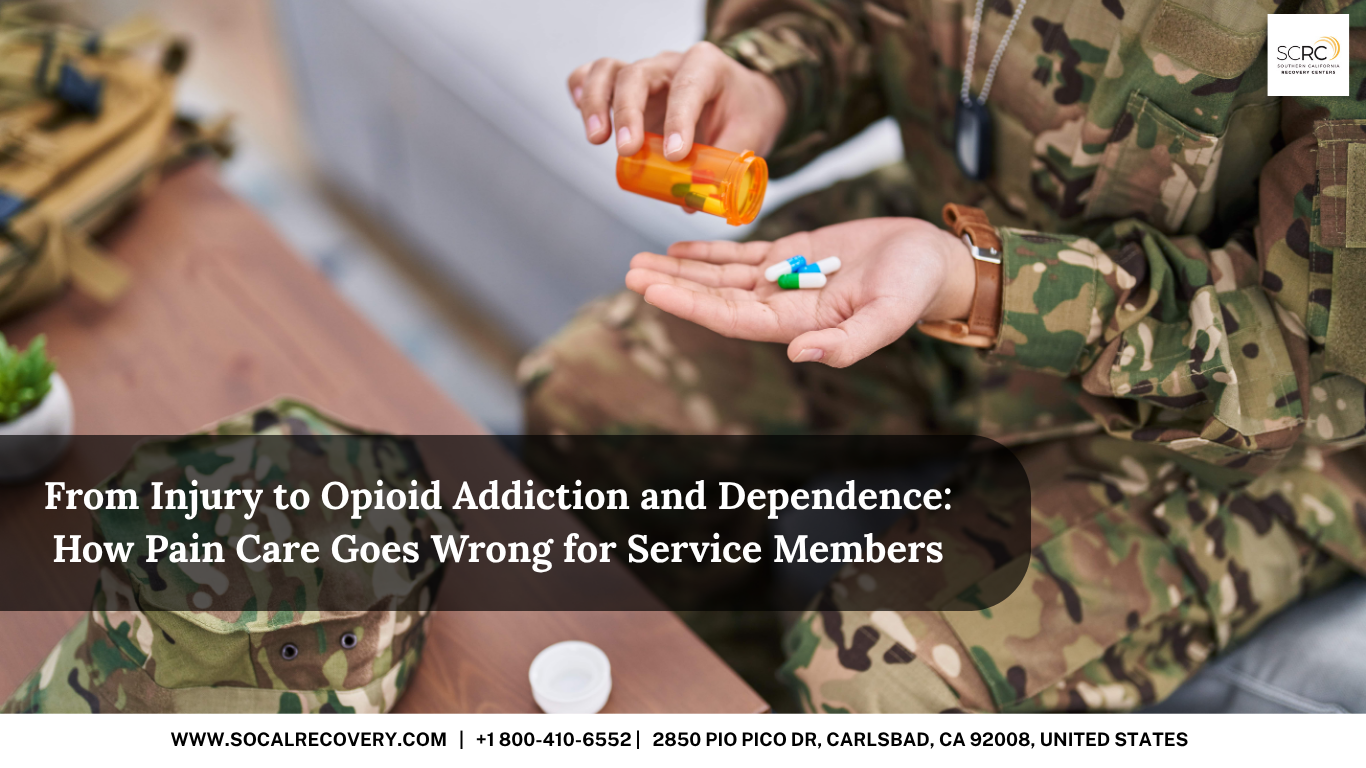
Opioid addiction and dependence in service members usually starts with a legitimate prescription for a real injury, not with misuse. A torn shoulder, a back injury from a training accident, surgery after deployment. The pills work at first. Then the dose creeps up, the pain stays, and nobody has a plan for what comes next.
The VA reports that the number of veterans with opioid prescriptions has dropped 67% since 2012, from 874,897 to 288,820 in 2023. It also notes that most veterans still prescribed opioids get them for short-term needs, such as surgery or an injury. That progress is real. The road from a first prescription to a dependence problem still exists, especially for people who hide pain to stay on duty.
This guide explains how pain care goes wrong, which warning signs to watch for, and what treatment looks like at Southern California Recovery Centers (SCRC).
If you or someone you serve with is already struggling, call SCRC at (800) 410-6552 for a confidential assessment. You can also verify your insurance online, and our page on rehab for active duty military explains how we work with service members.
Key Takeaways
- Physical dependence is not the same as addiction. Dependence means the body has adapted. Addiction, called opioid use disorder, adds loss of control and continued use despite harm.
- The pattern is predictable. Injury, prescription, tolerance, higher dose, then a crisis such as a cut-off or a street purchase.
- Service members face extra barriers. Pressure to stay on duty, fear of career impact, frequent moves, and untreated trauma all make pain care harder.
- Early signs of opioid dependence include needing more for the same relief, withdrawal between doses, and thinking about the next pill.
- Stopping suddenly is risky. A supervised taper or medical detox is safer than quitting alone.
- Help is confidential and available. SCRC treats prescription pill addiction in North County San Diego and works with Tricare and most major insurers.
What Are Opioid Addiction and Dependence, and How Do They Differ?
Physical dependence means your body has adapted to an opioid and reacts with withdrawal when the drug is reduced or stopped. Addiction, which doctors call opioid use disorder, adds cravings, loss of control, and continued use despite harm. A person can be dependent without being addicted. Dependence does raise the risk of addiction.
Doctors separate three terms that people often mix up:
| Term | What it means | What it looks like |
| Tolerance | The same dose works less over time | Needing more medication for the same relief |
| Physical dependence | The body reacts when the drug stops | Sweating, aches, and restlessness when a dose is late |
| Opioid use disorder (addiction) | Loss of control and harmful use that continues | Taking pills early, hiding use, buying pills off the street |
The National Institute on Drug Abuse has cited research suggesting that roughly 8 to 12 percent of people on long-term opioid therapy for chronic pain develop an opioid use disorder. That means most people do not. It also means the risk is far from small.
How Does a Military Injury Lead to Prescription Opioid Addiction?
It happens in steps, usually over weeks or months, not overnight. Prescription opioid addiction rarely begins with recreation. It begins with pain that deserves treatment.
Here is a pattern that shows up again and again in military pain care:
- The injury. A training accident, a deployment injury, or a surgery leaves real, ongoing pain.
- The prescription. Opioids are given for short-term relief, often with refills.
- Tolerance. The same dose stops working, so the dose goes up or the pills are taken more often.
- Dependence. Skipping a dose brings sweats, anxiety, and aches. The person now takes pills to feel normal, not just to ease pain.
- The break point. The prescription ends, a provider tapers too fast, or the supply runs out. This is where many people turn to leftover pills, a friend’s supply, or street drugs.
Research backs up how common the starting point is. A JAMA Internal Medicine survey of 2,597 soldiers back from deployment found that 44% reported chronic pain and more than 15% had recently used opioids for it.
Why Does Pain Care Go Wrong for Service Members?
Pain care goes wrong when pain is treated as a prescription problem instead of a whole-person problem. Military life adds pressure to hide symptoms, delay care, and push through. Here is where the system tends to break:
| Gap | What goes wrong | What helps instead |
| Pills as the default | Opioids are used for pain that also needs rehab, sleep, and mental health care | Physical therapy, non-opioid options, and pain-focused CBT alongside any short opioid course |
| No exit plan | The dose continues after the injury has healed | A stop or review date set at the first prescription |
| Moves and handoffs | A new station means a new provider with an incomplete history | A written medication history carried to every appointment |
| Silence about side effects | Fear of looking unfit keeps problems hidden | Telling the prescriber early and asking how confidentiality works |
| Abrupt tapers | Pills are cut fast and pain and withdrawal return together | A slow, supervised taper with support |
| Untreated trauma and poor sleep | Pills get used to numb nightmares and stress | Treating PTSD, sleep, and pain together |
Two points deserve extra attention.
First, the evidence for long-term opioids is weaker than most people expect. The updated VA/DoD guideline review reported by US Medicine said opioids can help some musculoskeletal pain in the short term, but the effects are small and carry adverse events.
Second, stigma is a clinical risk factor. A military health review notes that historic gaps in confidentiality and zero-tolerance policies can stop service members from asking for help when opioid use becomes a problem.
What Are the Signs of Opioid Dependence?
The most reliable signs of opioid dependence are needing more medication for the same relief, feeling sick between doses, and spending a lot of time thinking about the next pill. Any one sign deserves attention. Several together suggest it is time to talk to a professional.
Early signs of opioid dependence
- Taking pills earlier than prescribed, or more than prescribed
- Feeling anxious, sweaty, or achy when a dose wears off
- Worrying about running out
- Needing a higher dose for the same effect
- Pain that feels worse overall, even though you take more
Opioid use disorder symptoms
Clinicians use 11 criteria to diagnose a use disorder. Two or three is mild, four or five is moderate, and six or more is severe. In plain language, opioid use disorder symptoms include:
- Using more, or for longer, than intended
- Trying to cut down and not managing it
- Strong cravings
- Spending a lot of time getting, using, or recovering from opioids
- Missing duty, work, or family obligations
- Continuing despite relationship, health, or legal problems
- Giving up activities that used to matter
- Using in risky situations, such as before driving
- Tolerance and withdrawal
Red flags specific to service members
- Getting prescriptions from more than one provider
- Hiding pills from your unit, spouse, or command
- Using alcohol or sleep aids with opioids
- Pulling away from your unit or battle buddies
If this list sounds familiar, our page on prescription pills treatment explains what the next step looks like.
What Happens When Opioids Are Stopped Too Fast?
Stopping opioids suddenly can trigger withdrawal, uncontrolled pain, and a dangerous pull toward any available pill. A review in the Journal of Hospital Medicine notes that when access to prescription opioids is restricted, some veterans self-treat with diverted pills or switch to illicit drugs such as heroin, which raises overdose risk because there is no medical oversight.
The risk is higher today because counterfeit pills may contain fentanyl. A person who thinks they are taking a familiar pain pill may not be.
In general, withdrawal from short-acting opioids follows this pattern:
- 8 to 24 hours after the last dose: restlessness, sweating, yawning, anxiety
- Days 2 to 3: often the peak, with cramps, nausea, diarrhea, and muscle aches
- About a week: physical symptoms ease, though poor sleep and low mood can last longer
Withdrawal is rarely life-threatening on its own, but it is miserable, and that misery is what drives many relapses. Do not stop on your own. Talk to your prescriber about a taper, or look into drug detox with medical support.
How Does SCRC Treat Opioid Addiction in North County San Diego?
SCRC treats opioid addiction through detox, residential and outpatient care, and individual therapy, with the same in-house clinical team following you through each stage. The goal is to treat the pain history, the dependence, and any trauma underneath it together.
Founded in 2012, Southern California Recovery Centers serves people across North County San Diego, including Carlsbad, Cardiff by the Sea, Oceanside, and Encinitas. If you have been searching for opioid rehab near me, the Carlsbad location is a good place to start.
Here is how getting started works:
- Call (800) 410-6552. A confidential conversation with our admissions team costs nothing.
- Complete an assessment. We look at your substance use, pain history, mental health, and military background.
- Verify your insurance. SCRC works with most insurance providers, including Tricare, and acts as a liaison with your insurer.
- Begin detox if needed. Medical needs, including medication decisions, are reviewed at admission.
- Start therapy. Treatment includes CBT, DBT, EMDR, Seeking Safety, and Somatic Experiencing, plus mindfulness, yoga, and fitness work.
- Plan aftercare. This can include support groups, sober living, and our alumni program.
On confidentiality: SCRC follows HIPAA, and seeking treatment does not automatically lead to career consequences. Reporting rules inside the military can vary by situation, so ask about yours on the first call. Our admissions page covers the process, and you can contact us with any question.
No program can promise a specific outcome. Recovery depends on the person, the length of use, and the support around them. What a good program can do is give you a structured, supported start.
How Can Family Members Help?
Start with a calm, specific conversation, not an accusation. Families often notice changes first: mood swings, missed commitments, and secrecy around medication.
- Describe what you see. “You have seemed exhausted and distant since the surgery” lands better than “you have a problem.”
- Ask about the pain. Many service members will talk about pain before they will talk about pills.
- Learn the warning signs. Review the lists above together if it feels right.
- Keep naloxone at home. Ask a pharmacist about naloxone (Narcan), which can reverse an opioid overdose.
- Look after yourself. Family members need support too. SCRC invites families to attend family group sessions so everyone heals together.
Ready to Talk? Your Call Is Confidential.
Pain that started with service should not end your health or your career. Call Southern California Recovery Centers at (800) 410-6552, verify your insurance, or read more on our Resources page.
Pain Is Real. So Is Recovery.
Opioid addiction and dependence can follow anyone who is prescribed opioids for a serious injury, and service members carry more risk factors than most. Understanding the pattern gives you a head start. If you recognize it in yourself or someone you love, reaching out early is the best move you can make.
Call Southern California Recovery Centers at (800) 410-6552 for a confidential assessment. We will help you sort out insurance, answer your questions, and talk through what comes next.
Medical disclaimer: This article is for general education and does not replace advice from a licensed medical professional. Do not stop or change a prescribed medication without talking to your prescriber. If you or someone else is in crisis, call 911 or the 988 Suicide & Crisis Lifeline (veterans can press 1).
Get Support for Opioid Addiction and Dependence
When prescription pain medication becomes difficult to manage, getting the right support can make a difference. Southern California Recovery Centers offers individualized addiction treatment for service members, veterans, and others navigating prescription opioid dependence. Speak with our team to discuss treatment options, insurance coverage, and the next steps toward recovery.
Get Confidential Help Today