
In clinics like Southern California Recovery, doctors often see people who ask the same hard question: “Is this just heavy drinking, or is it a real disorder?” A clear diagnosis matters because it helps you get the right kind of help, at the right level, instead of guessing.
To explain Alcohol Use Disorder (AUD) and how doctors use the Alcohol Use Disorder DSM-5 criteria to diagnose it, rate its severity, and document the Alcohol Use Disorder DSM-5 code for medical records.
What Alcohol Use Disorder Is and Why Diagnosis Matters
Alcohol Use Disorder (AUD) is a medical condition. It means alcohol use has started to cause real problems in your life, your health, your safety, or your ability to stop when you want to. In the DSM-5-TR, AUD is defined as a pattern of alcohol use that leads to clinically significant impairment or distress, shown by symptoms that fit the DSM-5 list.
A correct diagnosis matters because it helps answer important questions like these:
- Do you need brief counseling or a more structured plan?
- Are there health risks that need medical care?
- Is your drinking linked to stress, anxiety, sleep problems, or trauma?
- Do you need support to prevent relapse after you cut down?
Diagnosis is not about judging you. It is about understanding what is happening and choosing the safest next step.
DSM-5 Alcohol Use Disorder: 11 Criteria Explained Simply

Doctors diagnose AUD by checking whether you have had at least 2 of these 11 criteria during the same 12-month period.
Alcohol Use Disorder DSM-5 criteria
1) Drinking more, or for longer, than you planned
You intended “one or two,” but it keeps going.
2) Wanting to cut down, but not being able to
You try to stop or reduce, but it does not last.
3) Spending a lot of time on alcohol
Time spent getting alcohol, drinking, or recovering.
4) Craving
Strong urges that feel hard to ignore.
5) Alcohol affects responsibilities
Work, school, home duties, or parenting slip because of drinking.
6) Continued drinking despite relationship problems
Arguments, trust issues, or social problems keep happening, but drinking continues.
7) Giving up important activities
You stop hobbies, sports, family time, or social events because alcohol is taking over.
8) Drinking in risky situations
For example, drinking before driving or in situations where it is unsafe.
9) Continued drinking despite physical or mental harm
You know it is worsening health, mood, sleep, or anxiety, yet it continues.
10) Tolerance
Needing more alcohol than before to feel the same effect.
11) Withdrawal
Feeling unwell when alcohol wears off, or drinking to avoid those symptoms.
Did you know?
Many people assume “alcoholism” is a single label. DSM-5 uses Alcohol Use Disorder instead, and it measures severity based on how many criteria fit your life.
How Doctors Apply DSM-5 Criteria in Real Diagnosis
Doctors do not diagnose AUD from one question like “How much do you drink?” They usually use a step-by-step approach.
How doctors diagnose Alcohol Use Disorder, DSM-5 criteria in real life
Step 1: They ask about your drinking pattern
- How many days per week?
- How many drinks on a typical day?
- Any binges (many drinks in a short time)?
- This helps set context, but it does not diagnose on its own.
Step 2: They check the 11 DSM-5 criteria with examples
A doctor may ask, “In the past 12 months, has this happened?” Then they ask for real-life proof, like missed work, fights at home, or failed attempts to stop.
Step 3: They look for impact and impairment
The DSM-5-TR focuses on impairment or distress.
So the doctor asks:
- What is alcohol doing to your sleep, mood, energy, or health?
- Has it affected your job, school, or family life?
- Are you taking risks you would not take while sober?
Step 4: They rule out common look-alikes
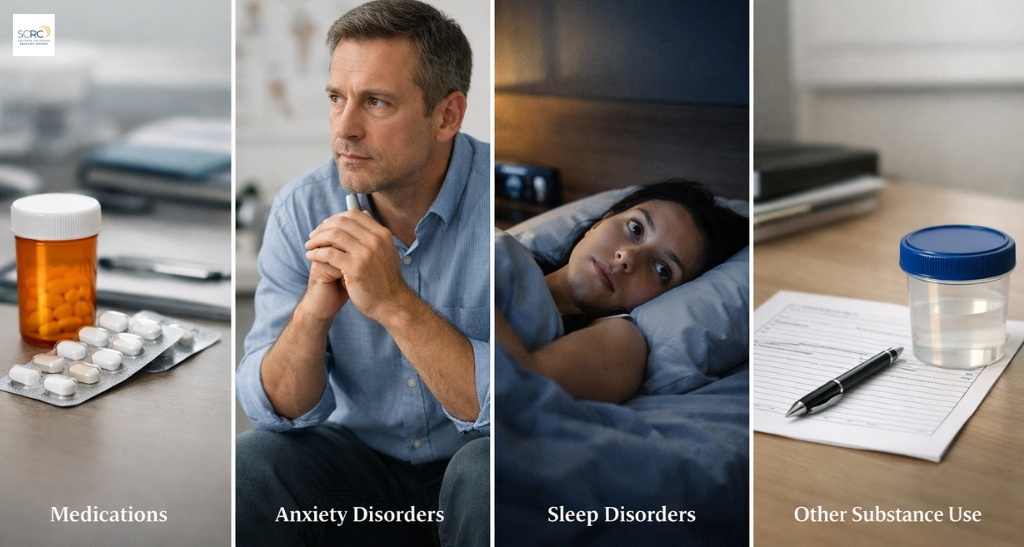
Some problems can mimic AUD symptoms, like:
- Certain medications
- Anxiety disorders
- Sleep disorders
- Other substance use
- That is why a real assessment matters.
Step 5: They check safety and medical risk
If a person may be physically dependent, stopping suddenly can be unsafe for some people. A doctor may plan a safer approach and may suggest medical monitoring when needed.
In settings like Southern California Recovery, clinicians often combine DSM-5 checks with structured screening tools and a full history so the diagnosis is not rushed or based on assumptions.
Mild, Moderate, and Severe Alcohol Use Disorder Levels
Severity is based on how many DSM-5 criteria you meet in the past 12 months:
| Level (DSM-5) | Number of Criteria Met | What it often looks like |
| Mild | 2–3 | Early loss of control, repeated regret, early life impact |
| Moderate | 4–5 | Clear impairment, stronger cravings, more frequent consequences |
| Severe | 6+ | Major life disruption, high risk, often tolerance/withdrawal |
Did you know?
Because severity can change, a person’s diagnosis can also change over time. When symptoms reduce and stay reduced, doctors may document “in remission” in medical records using specific coding language.
Alcohol Use Disorder DSM-5 Code and Medical Use
Doctors and clinics use diagnosis “codes” for medical records and insurance claims. You may see DSM-5-style labels and ICD-10-CM codes.
Alcohol Use Disorder DSM-5 code (common coding basics)
Many clinical references pair AUD severity with ICD-10-CM codes like:
- F10.10 is often used for Alcohol Use Disorder, Mild
- F10.20 is often used for Alcohol Use Disorder, Moderate or Severe
You might also see older DSM code numbers listed alongside ICD-10-CM mappings in some checklists, but most modern medical billing relies heavily on ICD-10-CM code sets.
Important note: Codes can also include extra details, such as “in remission,” which may change the exact code used in documentation.
Get Clear Answers About Your Drinking
If you’re questioning whether alcohol is becoming a problem, this is the right place to get clarity. Talk to someone who understands and get guidance without judgment.
Talk NowFAQs
1) How many DSM-5 criteria are needed for an Alcohol Use Disorder diagnosis?
A doctor generally diagnoses Alcohol Use Disorder when 2 or more of the 11 DSM-5 criteria occur within the same 12-month period.
2) What is the difference between alcohol dependence and Alcohol Use Disorder?
DSM-5 moved away from separate “abuse” and “dependence” labels and now uses one diagnosis: Alcohol Use Disorder, measured by symptom count and severity.
3) Can you have Alcohol Use Disorder if you do not drink every day?
Yes. AUD is about the pattern and impact, not only frequency. Some people binge drink and still meet multiple DSM-5 criteria.
4) What does mild Alcohol Use Disorder mean in DSM-5?
Mild AUD means that 2–3 criteria have been present in the past 12 months.
5) What are common ICD-10 codes used for Alcohol Use Disorder?
Many references list F10.10 for mild AUD and F10.20 for moderate/severe AUD, with additional codes used for remission status.
6) Can a diagnosis change over time?
Yes. If symptoms reduce and remain reduced, clinicians may document improvement in severity or remission over time, according to the criteria.
Conclusion
If alcohol is starting to affect your choices, your mood, your school or work, or your relationships, it is worth getting a real assessment. The Alcohol Use Disorder DSM-5 criteria give doctors a clear, fair way to diagnose AUD and match care to what you actually need. At Southern California Recovery, we are familiar with these steps and how to explain.