Objective
Answer, with real clinical accuracy, how long cocaine stays in your system across urine, blood, saliva, and hair follicle tests. Explain the biology behind detection windows and half-life in plain language, and connect that information to real treatment options at Southern California Recovery Centers for anyone facing repeated positive tests or a pattern of use they can’t seem to stop.
Key Takeaways
- Cocaine itself leaves the bloodstream fast. Its main byproduct, benzoylecgonine, sticks around much longer, up to 3 days in urine for most people and up to two weeks with heavy, repeated use.
- Half-life and detection time are not the same thing. Cocaine’s half-life is roughly an hour, but that has almost nothing to do with when a test comes back clean.
- Detection windows differ by test: saliva and blood catch use from the last day or two, urine picks up 2 to 4 days back (longer with heavy use), and hair follicle testing reaches back a full 90 days.
- Dosage, how often someone uses, metabolism, body fat, hydration, and liver health all push these numbers up or down.
- Trying to rush cocaine out of your system with water, exercise, or detox drinks doesn’t work the way people hope, and it can backfire.
Table of Contents
- What Happens to Cocaine Once It’s in Your Body?
- How Long Does Cocaine Stay in Your System by Test Type?
- Why Does One Test Catch It and Another Doesn’t?
- What Actually Changes Your Detection Window?
- Isn’t Half-Life the Same as Detection Time?
- Can You Speed Up How Fast Cocaine Leaves Your Body?
- What Does Treatment for Cocaine Use Actually Look Like?
- FAQ
- Conclusion
Someone gets a text about a drug screen tomorrow morning, or a court date shows up on the calendar next week, and the panic sets in fast. They’re up at midnight searching for an answer that doesn’t really exist as one clean number.
That’s because there isn’t a single answer. It comes down to which test is being used, how often the person has been using, and a few biological details most people never think about until a cup or a swab is in front of them.
We hear this question a lot at Southern California Recovery Centers, and it’s rarely just about the test. So here’s the real breakdown, test by test, along with what that timeline usually means for someone who’s finally ready to be done with it.
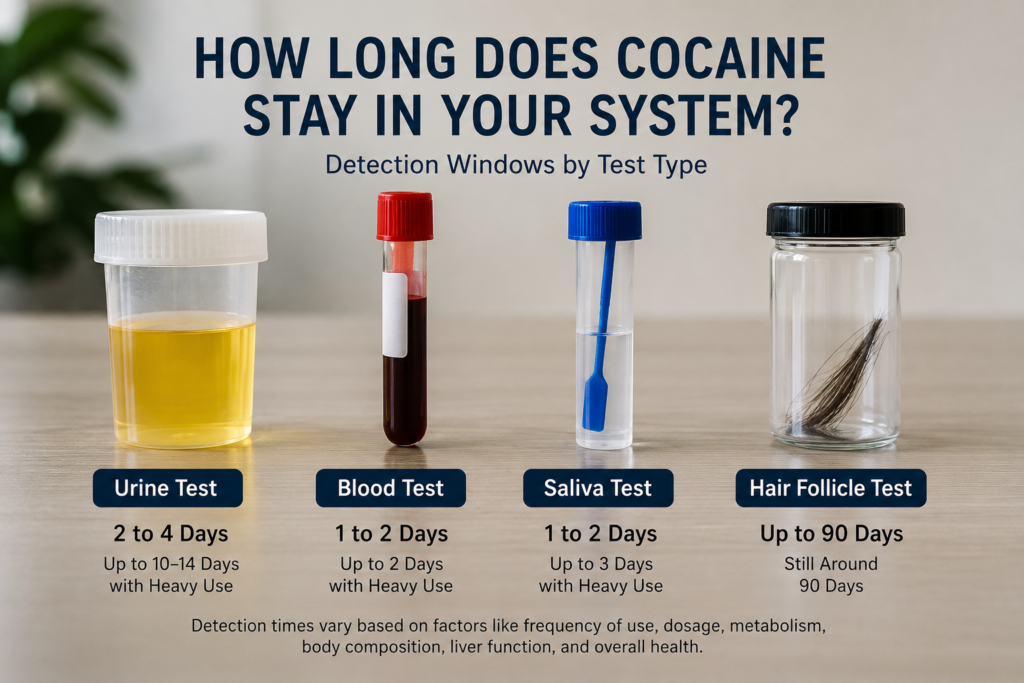
Cocaine clears the bloodstream within hours, but its metabolite, benzoylecgonine, stays detectable in urine for 2 to 4 days (longer with heavy use), 1 to 2 days in blood and saliva, and up to 90 days in hair follicle testing. Frequency of use, metabolism, body fat, and liver health all shift these numbers. If repeat testing has become a regular part of your life, that’s usually less about the test and more about a pattern worth talking to someone about.
What Happens to Cocaine Once It’s in Your Body?
Cocaine gets absorbed fast, and the liver goes to work breaking it down almost as quickly. What’s left behind after that breakdown is what actually shows up on a drug test, not the cocaine itself.
Once it enters the bloodstream, whether it’s snorted, smoked, or injected, liver enzymes convert most of it into a compound called benzoylecgonine. This is the metabolite standard drug tests are built to detect, and it hangs around in the body far longer than cocaine does. That’s the whole reason the high fades in an hour while a test can still catch it days later.
A smaller portion breaks down into ecgonine methyl ester, and traces of unmetabolized cocaine can also turn up, usually in blood or saliva drawn shortly after use.
If repeat testing has become part of your routine because the use itself hasn’t stopped, it might be time to look at cocaine addiction treatment centers instead of trying to manage the next test on your own.
How Long Does Cocaine Stay in Your System by Test Type?
How long does cocaine stay in your system comes down almost entirely to the test. Saliva clears in about a day or two. Hair follicle testing can catch use from three months ago.
| Test Type | Typical Detection Window | Heavy or Frequent Use |
| Saliva | 1 to 2 days | Up to 3 days |
| Blood | 1 to 2 days | Up to 2 days |
| Urine | 2 to 4 days | Up to 10 to 14 days |
| Hair Follicle | Up to 90 days | Still around 90 days |
Urine testing is the one most people run into, whether it’s for employment or ongoing treatment monitoring. Benzoylecgonine concentrates well in urine, which is why it stays measurable for several days after use.
Blood testing has a much tighter window. Once cocaine and its metabolites move out of active circulation, blood samples stop picking them up quickly.
Saliva testing tends to show up in roadside stops or same-day screenings, since it’s really only useful for catching use from the last 24 to 48 hours.
Hair follicle testing works on a completely different principle. It’s not looking for recent use at all. As hair grows, it locks in trace metabolites from the bloodstream, building a kind of timeline that stretches back roughly three months.
Why Does One Test Catch It and Another Doesn’t?
Every test is sampling a different part of the body, and each one moves at its own pace. Blood and saliva show what’s circulating right now. Urine and hair show what’s built up over time.
Blood and saliva are pulled straight from active circulation, so they only have a short window before the substance gets filtered out or broken down further.
Urine reflects what the kidneys have already processed, which is why it can still detect use days after blood has already come back clean.
Hair works differently from all three. As it grows, the hair shaft absorbs trace metabolites straight from the bloodstream, which is how it ends up holding a record instead of a snapshot.
What Actually Changes Your Detection Window?
No two people clear cocaine at the same speed. Dosage, how often someone uses, metabolism, body composition, hydration, liver function, and general health all move the timeline in real ways.
- Dosage. A bigger dose takes the liver longer to fully process.
- Frequency of use. Regular use builds metabolite reserves in fat tissue, which stretches detection windows well past what a single-use timeline would suggest.
- Metabolism. A faster metabolic rate generally clears substances quicker, though this shifts with age and individual biology.
- Body composition. Cocaine metabolites bind to fat tissue, so someone with a higher body fat percentage can test positive longer than someone leaner using the same amount.
- Hydration. Staying hydrated keeps kidney filtration working normally, but overdoing it doesn’t clear metabolites any faster. It mostly just dilutes the sample, and labs are trained to flag that.
- Liver function. Since the liver does most of the work here, anything that impairs it, heavy alcohol use, for example, can slow the whole process down.
- Overall health. Kidney function, age, and general wellbeing all play a role in how efficiently the body clears these metabolites.
Here’s what that looks like in practice. Someone using cocaine occasionally on weekends might test negative on a urine screen within three days. Someone using daily for weeks has metabolites stored in fat tissue, and that same test can stay positive closer to two weeks after their last use.
Isn’t Half-Life the Same as Detection Time?
No, and this is where most of the confusion starts. Cocaine’s half-life is about an hour. Detection time is measured in days, sometimes weeks. They’re answering two different questions.
Half-life tells you how fast the concentration in your blood drops by half. It has nothing to do with when a test stops picking it up. People assume that because the high fades in an hour or two, the drug is gone. It isn’t. The parent compound clears fast, but benzoylecgonine has a half-life closer to 12 hours, and it takes several of those cycles before it drops below what a test can detect.
There’s a rough rule in pharmacology: a substance is considered mostly cleared after about five half-lives. For benzoylecgonine at roughly 12 hours, that lands around two and a half days for lighter use. Heavy or repeated use pushes that number out considerably, since there’s more built up in tissue to work through.
Can You Speed Up How Fast Cocaine Leaves Your Body?
Not really. Detox drinks, chugging water, and home remedies don’t change how fast the liver metabolizes cocaine, because that process runs on its own fixed timeline, not on anything happening in your bladder.
Here’s where the common advice falls apart:
- Drinking excessive water dilutes the urine sample but doesn’t clear metabolites from the bloodstream any faster, and labs specifically test for dilution.
- “Detox” drinks and supplements aren’t regulated or clinically proven, and some contain diuretics that can leave you dehydrated or throw off your electrolytes.
- Exercising before a test can actually release stored metabolites from fat tissue back into the bloodstream, which sometimes raises detectable levels instead of lowering them.
- Cranberry juice, vitamin C, and similar tricks have no real clinical evidence behind them.
The liver runs at a fixed enzymatic pace. Nothing sold at a gas station or pharmacy changes that.
If testing anxiety has become a regular thing, that’s worth sitting with for a second. It’s usually less about the test and more about where the use has landed. A confidential assessment with our team is a low-pressure way to talk it through.
What Does Treatment for Cocaine Use Actually Look Like?
Treatment for cocaine dependence starts with medically supervised detox, then moves into structured therapy and relapse prevention. It’s a process, not a single appointment, and it works better with real support behind it.
Assessment first. Our clinical team looks at physical health, mental health history, and use patterns before building a plan. Nobody gets a generic template here.
Supervised detox. Cocaine withdrawal isn’t usually life-threatening the way alcohol or benzodiazepine withdrawal can be, but it’s still rough: fatigue, depression, intense cravings, irritability, disrupted sleep. Medical supervision keeps someone safe and supported through that stretch instead of white-knuckling it alone.
Therapy that actually digs in. We use evidence-based approaches like CBT and DBT, along with trauma-focused work such as EMDR and Seeking Safety Therapy. A lot of cocaine use is sitting on top of trauma that’s never been dealt with directly.
Structure and life skills. Clients build daily routines, accountability, and vocational skills that carry them past treatment, not just through it.
Aftercare that doesn’t end at discharge. Ongoing therapy, sober living referrals, and our alumni community help lower relapse risk in those first shaky months out.
Signs it might be time to reach out:
- Testing positive repeatedly despite meaning to stop
- Using cocaine to manage stress, anxiety, or a bad mood
- Needing more, more often, than you used to
- Fatigue, low mood, or cravings showing up when you’re not using
- Work, money, or relationships taking hits because of it
Southern California Recovery Centers has been doing this work since 2012, with facilities in Carlsbad and Cardiff-by-the-Sea, serving clients across North County San Diego, including Encinitas and Oceanside. Family is part of the process here too, since this rarely affects just one person in a household.
Ready to talk it through? Verify your insurance or start the admissions process today. Every conversation with our team stays confidential.
FAQ
How long does cocaine stay in your system for a standard urine test?
Most people test negative within 2 to 4 days of last use. Heavy or frequent users can stay positive for up to 10 to 14 days because metabolites build up in fat tissue.
Does cocaine show up on a standard 5-panel drug test?
Yes. Cocaine metabolites are part of standard 5-panel screens and most extended panels used for employment or clinical testing.
Can secondhand exposure cause a positive cocaine test?
It’s extremely unlikely. Getting a detectable amount from secondhand exposure would take very close, prolonged contact, which isn’t a realistic situation for most people worried about this.
Why does hair follicle testing catch cocaine so much further back than urine?
Hair absorbs metabolites from the bloodstream as it grows, which builds a record stretching back roughly 90 days. Urine and blood only show a short window around recent use.
Does SCRC accept insurance for cocaine addiction treatment?
Yes. Our admissions team works directly with most major insurance providers to check your benefits and bring down out-of-pocket costs. You can check your coverage on our insurance verification page before committing to anything.
Is cocaine withdrawal dangerous enough to need medical detox?
It’s rarely life-threatening on its own, but symptoms like severe depression, intense cravings, and wrecked sleep are hard to manage safely without help. Medical supervision cuts down relapse risk during that early, vulnerable stretch.
How long does a cocaine treatment program usually last?
It depends on the person. Many clients stay 30, 60, or 90 days, and longer-term options are available for anyone who needs more time and structure.
Will my family be part of my treatment at SCRC?
Yes, and we build it in on purpose. We run family group sessions and encourage loved ones to participate, since this rarely stays contained to just the person using.
What’s actually different between cocaine’s half-life and its detection time?
Half-life is how fast the concentration in your blood drops by half, about an hour for cocaine. Detection time is how long metabolites like benzoylecgonine stay measurable in urine, blood, saliva, or hair, which runs much longer.
Does SCRC treat clients outside North County San Diego?
Yes. Our facilities are based in Carlsbad and Cardiff-by-the-Sea, but we treat clients from across California and beyond who want a structured, trauma-informed place to get well.
Break Free From Cocaine Addiction With Expert Care
If concerns about drug testing have become a regular part of your life, it may be time to focus on lasting recovery instead of temporary solutions. At Southern California Recovery Centers, we offer comprehensive cocaine addiction treatment through medically supervised detox, evidence-based therapies, individualized treatment plans, and ongoing recovery support. Our compassionate team is committed to helping you overcome addiction and build a healthier, substance-free future.
Begin Your Recovery Journey TodayConclusion
Cocaine’s high fades fast, but what it leaves behind doesn’t. Days in urine and blood, weeks for heavy users, up to three months in hair. Understanding that gap matters, but it’s usually not the real question underneath the search.
If you’re tracking test dates instead of living your life, that’s worth paying attention to. Southern California Recovery Centers has helped people step out of that cycle since 2012, treating the whole person, not just the substance.
Call us at (800) 410-6552 for a completely confidential conversation, or reach out through our contact page to get started.
This content is for informational purposes and has been reviewed for clinical accuracy. It is not a substitute for a professional medical evaluation. Please consult a licensed provider or contact our clinical team directly for guidance specific to your situation.