Objective: Help people in Southern California and their families understand what determines inpatient rehab duration, how 30, 60, and 90-day programs differ, and why completing the full recommended stay significantly improves long-term recovery outcomes.
Key Takeaways
- How long you should stay in rehab depends on addiction severity, substance type, co-occurring mental health conditions, and prior treatment history
- The 30-day program is a starting point, not a finish line, for most people with moderate to severe addiction
- 60-day and 90-day inpatient programs consistently produce better long-term outcomes than shorter stays
- Clinical assessments throughout treatment, not arbitrary calendar dates, should drive decisions about length of stay
- Leaving rehab early against clinical advice is one of the most reliable predictors of relapse
- Insurance often covers longer stays than people assume, and extensions are possible when clinically justified
- Southern California Recovery Centers offers inpatient rehab in Carlsbad and Dana Point for adults across all backgrounds
Table of Contents
- Why There Is No Universal Answer to Rehab Length of Stay
- The Factors That Actually Determine How Long Should You Stay in Rehab
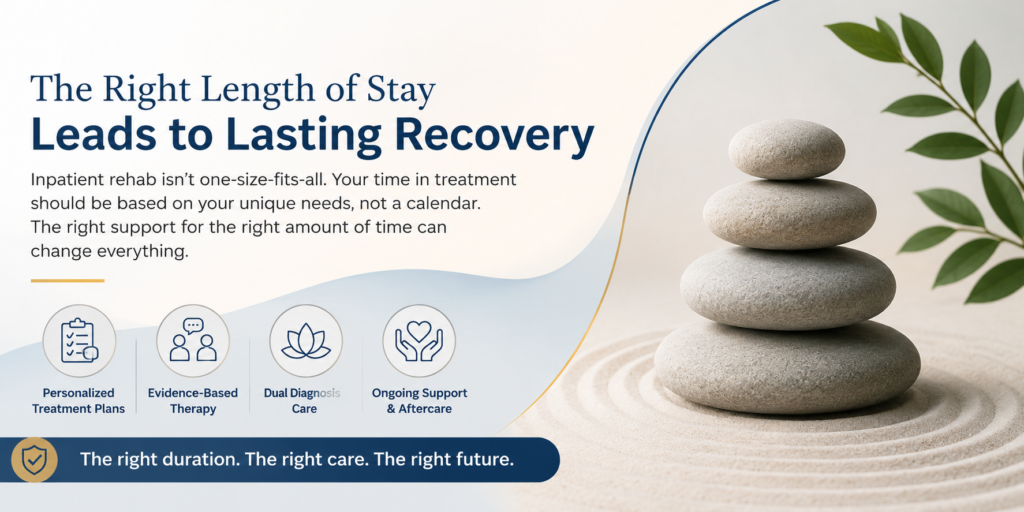
- 30-Day, 60-Day, and 90-Day Programs: What Each One Is Actually For
- How Clinical Assessments Drive the Recovery Timeline
- The Real Cost of Leaving Rehab Too Early
- Insurance, Treatment Planning, and Extending Your Stay
- What Comes After Inpatient Rehab: Transitioning to Aftercare
- Medical Note
- FAQs
One of the first questions almost every family asks when looking into treatment is how long rehab takes. It is a reasonable question. People have jobs, responsibilities, and lives they need to return to. The honest answer is that there is no single correct number, and the facilities that give you a confident number without knowing anything about the person are working from a business model, not a clinical one.
Inpatient rehab duration is determined by the person in front of the clinical team, not by a standard package. The right length of stay for someone who has been drinking a case of beer a day for ten years with untreated PTSD looks nothing like the right length of stay for someone who used cocaine recreationally for two years. Both deserve treatment. Neither deserves the same cookie-cutter program.
What follows breaks down the actual clinical factors that determine how long someone should stay in inpatient rehab, what each program length is designed to accomplish, and why cutting the stay short almost always costs more time in the long run. If you are trying to figure out the right level of care in Southern California, Southern California Recovery Centers has locations in Carlsbad and Dana Point and can walk you through the assessment process.
Why There Is No Universal Answer to Rehab Length of Stay
The 28-day or 30-day rehab model became standard in the United States largely for insurance-driven reasons, not clinical ones. Research has consistently shown that longer treatment duration is associated with better outcomes. But the addiction treatment industry standardized around the 30-day program for decades because it fit neatly within what many insurance plans would cover at the time.
That has changed. Evidence-based treatment planning now recognizes that rehab length of stay should be driven by clinical need, not convenience or calendar. The National Institute on Drug Abuse has long noted that treatment lasting less than 90 days has limited effectiveness for most people with significant addiction histories.
That does not mean everyone needs 90 days. It means the right duration is a clinical determination, made by people who understand what the person is dealing with, what progress looks like for their specific situation, and what aftercare structure they are returning to.
The Factors That Actually Determine How Long Should You Stay in Rehab
Several clinical variables consistently drive decisions about inpatient rehab duration. Understanding them helps patients and families push back on arbitrary timelines and advocate for the level of care that actually matches the situation.
Severity and duration of addiction
Someone who has been using opioids daily for five years has a fundamentally different neurological and behavioral starting point than someone who developed a problem over twelve months. Longer, more entrenched use generally requires more time for the brain to stabilize and for new behavioral patterns to take hold.
Substance type
Some substances are harder to withdraw from and require longer stabilization periods. Alcohol, benzodiazepines, and opioids all carry significant physical withdrawal that must be managed before meaningful behavioral work can begin. Stimulants like methamphetamine often produce extended psychological symptoms, including depression and anhedonia, that require sustained clinical support.
Co-occurring mental health conditions
Depression, PTSD, anxiety disorders, bipolar disorder, and ADHD all interact with substance use in ways that complicate recovery. When a mental health condition is driving substance use, treating only the addiction and leaving the psychiatric condition unaddressed is a clinical setup for relapse. Dual diagnosis cases almost always warrant longer inpatient stays.
Prior treatment history
Someone entering treatment for the first time has a different clinical picture than someone who has completed three prior programs. Multiple prior treatment episodes without sustained recovery suggest that the previous stays were too short, the wrong level of care, or failed to address the underlying drivers. More time, not less, is typically what changes the outcome.
Medical history and physical health
Liver damage, cardiovascular conditions, nutritional deficiencies, and other physical health factors affect how quickly someone stabilizes and how safely treatment can be delivered. Physical health complexity often extends the medically necessary portion of inpatient care.
Home environment and social support
Someone returning to a stable home with strong support and no access to substances can transition to outpatient care sooner than someone returning to an environment where substances are present, relationships are damaged, or social isolation is high. Rehab does not happen in a vacuum, and the destination matters when planning the duration.
30-Day, 60-Day, and 90-Day Programs: What Each One Is Actually For
These three program lengths are not interchangeable options on a menu. Each serves a distinct clinical purpose, and the right one depends on where the person is starting from.
| Program Length | Best Suited For | What It Covers |
| 30 days | Mild addiction, strong support system, first-time treatment, less complex clinical picture | Medical stabilization, initial behavioral work, introduction to recovery tools |
| 60 days | Moderate addiction, some prior treatment, early-stage co-occurring conditions, limited home support | Deeper behavioral work, beginning to address underlying issues, relapse prevention foundation |
| 90 days | Severe or long-term addiction, multiple prior treatment episodes, dual diagnosis, high-risk home environment | Full stabilization, sustained behavioral change, comprehensive dual diagnosis treatment, stronger aftercare readiness |
The 30-day program works for a specific subset of people. Those with shorter use histories, strong external support, no significant co-occurring conditions, and high internal motivation to sustain change. For everyone else, it is typically a starting point that needs to be extended based on clinical progress.
The 90-day program is not a punishment for not getting better fast enough. It reflects the actual time the brain needs to form new patterns, the time therapy requires to address trauma or psychiatric conditions meaningfully, and the time people need to build confidence in sober living before returning to environments that previously supported substance use.
How Clinical Assessments Drive the Recovery Timeline
Inpatient rehab is not a passive process where time in the program is the only variable. Clinical teams conduct ongoing assessments throughout treatment to evaluate how a patient is progressing and whether the current level of care remains appropriate.
These assessments typically look at:
- Physical stabilization and whether withdrawal symptoms have fully resolved
- Engagement with therapy and willingness to examine underlying issues
- Cognitive function and emotional regulation, both of which are affected by substance use and take time to restore
- Insight into the addiction, including acknowledgment of consequences and motivation for change
- Readiness for lower levels of care and the supports that will be in place upon discharge
A patient who enters a 30-day program and hits benchmarks consistently may be clinically ready to step down to PHP or IOP at 30 days. Another patient in the same program who struggles with early engagement, has more complex trauma, or shows limited emotional stabilization will need an extended stay. The clinical team drives that decision, not the calendar.
At Southern California Recovery Centers, treatment plans are built around each individual and revisited throughout the stay. The goal is never to rush someone through a program. It is to discharge them when they are genuinely ready, not when their time slot is up.
The Real Cost of Leaving Rehab Too Early
Leaving inpatient treatment against clinical advice, or choosing a shorter program than the clinical team recommends, is one of the most consistent predictors of relapse. This is not a judgment. It reflects how addiction and early recovery actually work.
The first weeks of inpatient treatment are largely consumed by physical stabilization, getting past the acute symptoms of withdrawal, beginning to sleep and eat normally, and starting to rebuild basic cognitive function. Behavioral change, therapy, trauma work, and skill-building come after stabilization. Cutting the stay short at 30 days often means leaving before the therapeutic work has had enough time to produce durable results.
The recovery timeline does not reset cleanly after a relapse. Returning to use after a short stay often means returning to the same use patterns faster than before, which means re-entering treatment in a more difficult position than the first time. A longer initial stay is almost always more efficient than multiple short ones.
Insurance, Treatment Planning, and Extending Your Stay
A common misconception is that insurance only covers 30 days. Most major insurance plans cover inpatient rehab based on medical necessity, not a fixed calendar limit. If the clinical team determines that continued inpatient care is medically necessary, that determination can be submitted to insurance for continued authorization.
Extensions are granted when documentation supports them. Clinical notes showing active psychiatric symptoms, ongoing substance cravings that present relapse risk, incomplete stabilization, or emerging clinical concerns all support continued authorization.
Southern California Recovery Centers works with most major insurance providers. The admissions team can verify your benefits before you commit to anything.Verify your insurance online or call (800) 410-6552 and someone will run your coverage immediately.
Treatment planning begins at admission and is updated throughout the stay. The team builds a plan that accounts for the individual’s history, the clinical factors identified at assessment, and the aftercare structure that will support sustained recovery after discharge. Discharge is part of the plan from the beginning, not an afterthought at day 29.
What Comes After Inpatient Rehab: Transitioning to Aftercare
Completing inpatient rehab is a significant clinical milestone. It is not the end of treatment. The transition from inpatient to the next level of care is one of the highest-risk periods in early recovery, and how it is handled matters enormously.
Most patients transition from inpatient into one of the following:
Partial Hospitalization Program (PHP): Several hours of structured programming per day, five days a week, while living in sober housing or at home. PHP maintains the intensity of inpatient care while allowing a gradual return to daily life responsibilities.
Intensive Outpatient Program (IOP): Less intensive than PHP, typically nine to twelve hours of programming per week. IOP allows people to return to work or school while maintaining structured therapeutic support and accountability.
Standard Outpatient and Ongoing Therapy: Individual therapy, group support, medication management if applicable, and continued psychiatric care for those with dual diagnosis conditions.
The inpatient rehab program at Southern California Recovery Centers builds aftercare planning into treatment from the start. Patients do not leave without a clear plan for what comes next because the clinical team understands that the period immediately after discharge carries significant risk. The alumni program at SCRC also provides continued community and accountability after treatment ends.
People in Carlsbad, Dana Point, and across Southern California have access to the full continuum of care at SCRC, from detox through inpatient through ongoing outpatient support.
Medical Note: This article is for informational purposes only and does not constitute medical advice. Treatment duration should be determined by a licensed clinical team based on individual assessment. Do not make decisions about length of stay or discharge timing without consulting the treating clinical team. If you or someone you love is in crisis, call 988 or go to the nearest emergency room. For information about rehab centers in Orange County California and Southern California, contact Southern California Recovery Centers at (800) 410-6552.
Find the Right Rehab Program Length for Lasting Recovery
Choosing how long to stay in rehab can have a major impact on long-term recovery success. Whether you need a 30-day, 60-day, or 90-day inpatient program, the right treatment duration should be based on your unique clinical needs—not an arbitrary timeline. Southern California Recovery Centers provides individualized inpatient rehab programs, dual diagnosis treatment, and comprehensive aftercare planning to help adults build a strong foundation for lasting sobriety.
Verify Your Insurance & Get Started TodayFrequently Asked Questions
How long should you stay in rehab for alcohol addiction specifically?
Alcohol addiction with physical dependence typically requires a minimum of 30 days just to move through medical detox and initial stabilization. Most people with a meaningful history of heavy daily drinking benefit from 60 to 90 days of inpatient treatment. The length depends on how long they have been drinking, prior withdrawal history, co-occurring mental health conditions, and what home environment they are returning to. A clinical assessment at admission will give a clearer picture of what is actually needed.
Can I leave inpatient rehab before my program is scheduled to end?
Legally, yes. Clinically, it is one of the most common reasons people end up back in treatment within weeks or months. Leaving against clinical advice significantly increases relapse risk, particularly if it happens before the behavioral and therapeutic work has had time to produce change. If something about the program is not working, the right move is to raise it with the clinical team, not to discharge. Problems with the program are almost always solvable. Early discharge is not always recoverable.
Does insurance cover more than 30 days of inpatient rehab?
Most major insurance plans cover inpatient rehab based on medical necessity, not a calendar limit. If your clinical team documents that continued inpatient care is medically necessary, that can be submitted for continued authorization. Extensions are granted regularly when clinical documentation supports the need. Southern California Recovery Centers works directly with most major insurance providers. You can verify your benefits online or call (800) 410-6552 to have someone run your insurance before you commit.
What is the difference between a 30-day and 90-day rehab program beyond just the length?
A 30-day program covers medical stabilization and introduces recovery tools. A 90-day program builds on that foundation with sustained behavioral work, deeper therapeutic engagement, trauma processing, dual diagnosis treatment, and meaningful time practicing sober living skills in a structured environment. The additional time is not repetition. It is a different phase of clinical work that cannot be compressed into 30 days without sacrificing depth.
How do I know when someone is ready to leave inpatient rehab?
Readiness for discharge is a clinical determination, not a feeling. Indicators include full physical stabilization, consistent engagement with therapy, improved emotional regulation, insight into the addiction and its triggers, a solid aftercare plan in place, and a home or transitional living environment that supports continued sobriety. The clinical team at SCRC assesses these factors continuously and uses them to guide discharge timing rather than treating the calendar as the deciding factor.
What if my loved one refuses to stay in rehab for the recommended duration?
This is one of the most difficult situations families face. Refusal to stay the recommended course often reflects early-recovery thinking patterns, including minimizing the problem, overconfidence in the early progress made, and fear of what full engagement with therapy might uncover. Family therapy, which is part of the treatment model at Southern California Recovery Centers, can help families understand how to respond without enabling early discharge. Calling the clinical team directly to discuss the situation is always the right first step.
Conclusion
The length of time someone spends in inpatient rehab is one of the most consequential decisions in the early recovery process. It affects relapse rates, the depth of behavioral change, and the readiness someone brings to life after treatment.
Southern California Recovery Centers has been helping adults in Carlsbad, Dana Point, and across Southern California since 2012 with inpatient programs built around real clinical assessment, not generic timelines. The team works with most major insurance providers, builds individualized treatment plans, and supports patients through the transition to aftercare.
Call (800) 410-6552 or contact the admissions team online today. You can also verify your insurance before making any decisions. The first conversation is confidential.