Key Takeaways
- Rebound insomnia is a well-documented, temporary spike in sleeplessness that can hit when someone stops a sleep medication, sometimes worse than the insomnia that sent them to the medication in the first place.
- Stopping sleeping pills safely almost always means tapering the dose down gradually rather than quitting outright. Abruptly stopping benzodiazepines or Z-drugs like zolpidem can trigger real withdrawal, including anxiety, seizures in rare cases, or worse rebound insomnia.
- Rebound insomnia after stopping medication usually peaks in the first few nights after a dose cut and settles within one to two weeks, though it can drag on longer depending on how long someone used the medication.
- Reducing sleeping pill use works best paired with Cognitive Behavioral Therapy for Insomnia (CBT-I), the evidence-based, drug-free treatment that’s been shown to outperform medication for lasting sleep improvement.
- Sleep problems after discontinuing medication are a predictable, short-term part of the process, not proof the medication is still needed, and understanding that distinction is what keeps people from reaching straight back for the pill bottle.
- Coming off sleeping medication should always happen with a prescriber involved, especially for benzodiazepines or long-term Z-drug use, where stopping abruptly carries genuine medical risk.
- If sleeping pill use has drifted from medical need into dependence or sleeping pill addiction,Southern California Recovery Centers (SCRC) offers medically supervised tapering as part of its broader prescription pill addiction treatment program.
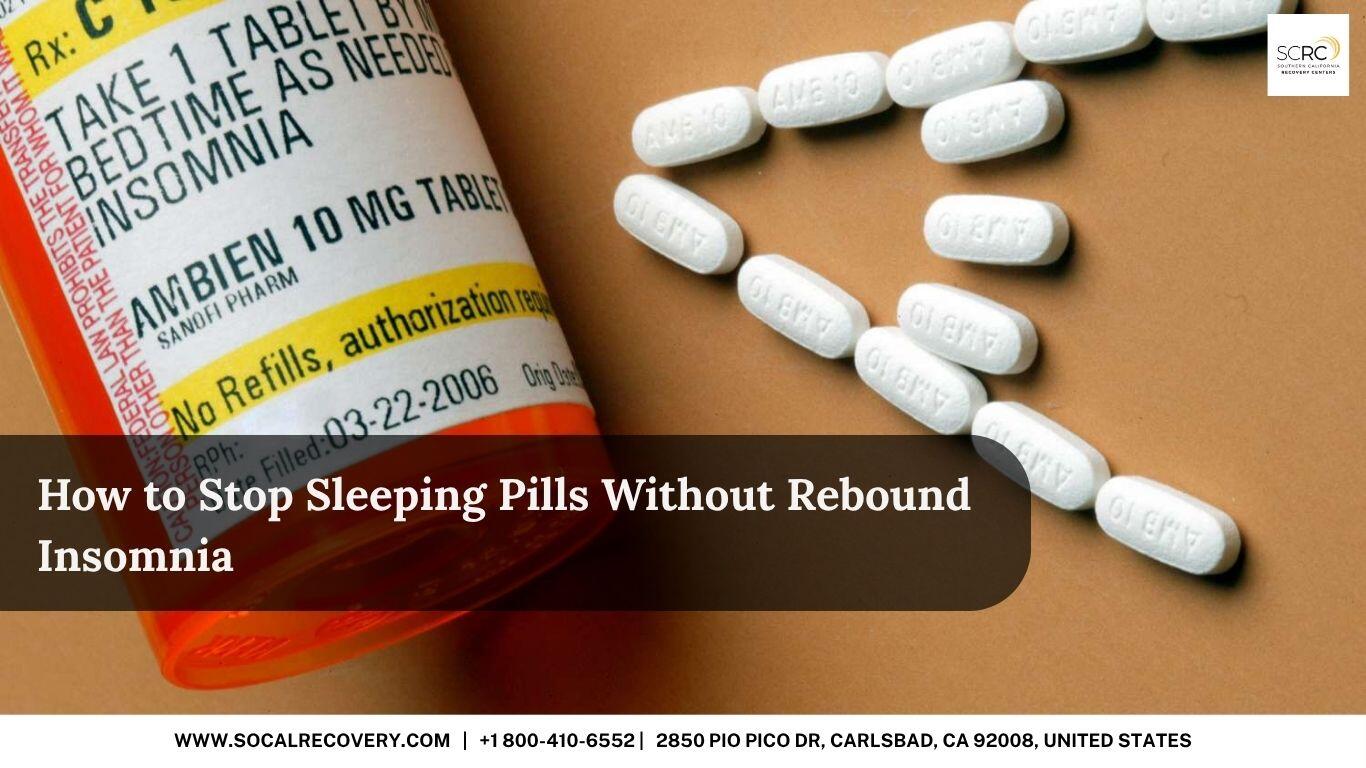
A woman who’s relied on Ambien for two years finally decides to quit. The first night off it, she doesn’t sleep at all. The second night is worse. By the third, she’s back at the pharmacy, convinced her insomnia has come roaring back and the medication was the only thing keeping it in check. What actually happened has a name, and it isn’t proof she needs the pill forever. It’s rebound insomnia, a well-documented, temporary reaction to stopping, and it follows a pattern most people are never warned about before they try to quit.
Rebound insomnia shows up with several classes of sleep medication, most notably benzodiazepines and the non-benzodiazepine “Z-drugs” like zolpidem, eszopiclone, and zaleplon. Both drug classes work on the same GABA receptors in the brain, which is exactly why stopping them can throw sleep into worse shape, temporarily, than it was before treatment ever started.
This guide walks through why rebound insomnia happens, how to taper off safely, and what actually helps sleep recover for good. If sleeping pill use has become harder to control than expected, SCRC’s prescription pill addiction treatment program offers medically supervised tapering built around exactly this situation. Call (800) 410-6552 any time.

What Is Rebound Insomnia, and Why Does It Happen?
Rebound insomnia is difficulty sleeping that shows up specifically because a sleep medication was stopped, a recognized, temporary side effect of certain sleep drugs, not a sign that the original insomnia never actually improved.
Both benzodiazepines and Z-drugs work by boosting the effect of GABA, the brain’s main calming chemical. With regular use, the brain adjusts to that extra boost and starts leaning on it. Once the medication stops, the brain needs time to recalibrate, and in that gap, sleep can genuinely get worse before it gets better.
A few things worth knowing upfront:
- Rebound insomnia is common and expected with certain sleep medications, not some rare complication.
- It’s often mistaken for the original sleep problem returning, which is exactly what pulls people back to the medication.
- It’s temporary. Clinicians describe it as having a predictable shape and a clear end point, not an open-ended decline.
Why Stopping Sleeping Pills Abruptly Is Risky
Stopping sleeping pills suddenly, especially benzodiazepines or Z-drugs used for months or longer, carries real withdrawal risk that goes well beyond rebound insomnia on its own.
What abrupt stopping can trigger:
- Sharper rebound insomnia. Sleep can become measurably worse than it was before treatment, at least for a while, and the intensity tends to track with how abruptly the dose got cut.
- Anxiety, restlessness, irritability. These commonly show up during withdrawal from both benzodiazepines and Z-drugs, since both act on the same receptor system.
- Rare but serious complications. With long-term or high-dose use, sudden discontinuation has been linked to more severe withdrawal, including seizures in rare cases.
- A stronger pull back to the medication. The discomfort of untreated withdrawal is often exactly what sends people back to the pills, reinforcing the same dependence they were trying to break.
This is why every major clinical guideline on this, including recent joint guidance on benzodiazepine tapering from professional medical societies, recommends a gradual, supervised reduction instead of stopping outright.
How Does a Safe Sleeping Pill Taper Actually Work?
A safe taper brings the dose down gradually, giving the brain’s GABA system time to readjust in stages instead of all at once, which meaningfully cuts down both withdrawal severity and how intense rebound insomnia ends up feeling.
What this generally looks like:
- A reduction schedule led by a prescriber. Dose decreases happen in planned steps, not guesswork, with the pace adjusted based on how someone’s actually responding.
- Smaller cuts as the dose gets lower. Clinical guidance points toward smaller reductions near the end of a taper, since the medication is still bound more strongly to brain receptors even at low doses.
- Sometimes switching medications first. For certain short-acting drugs, a prescriber may switch to something longer-acting before tapering, to smooth out the blood level swings that drive some withdrawal symptoms.
- Room to slow down. A good taper plan expects some weeks to go rougher than others and allows the pace to ease off without treating that as failure.
This isn’t something to work out alone from a forum post. How fast a taper should go depends heavily on the specific medication, the dose, and how long it’s been used, and a prescriber needs to be the one weighing all of that.
What Role Does CBT-I Play in Coming Off Sleep Medication?
Cognitive Behavioral Therapy for Insomnia (CBT-I) is the leading evidence-based, drug-free treatment for insomnia, and pairing it with a taper genuinely improves the odds of coming off sleep medication for good.
Core pieces of CBT-I include:
- Stimulus control. Only getting into bed when actually sleepy, and getting back up if sleep doesn’t come within roughly 20 minutes, to rebuild the brain’s link between bed and sleep.
- Sleep restriction. Temporarily limiting time spent in bed to match real average sleep time, then slowly expanding it as sleep efficiency improves.
- Cognitive restructuring. Directly challenging anxious thoughts about sleep, “if I don’t sleep tonight I’ll be useless tomorrow,” and swapping them for something more balanced.
- Relaxation techniques. Deep breathing, progressive muscle relaxation, or guided imagery, used to bring down physical tension at bedtime.
Research comparing short-term CBT-I plus tapering against tapering alone found the combined approach worked better for actually getting off the medication. CBT-I hands the brain a real alternative path to sleep, rather than just pulling the pill away and leaving nothing to replace it.
What Can You Expect in the First Few Weeks?
Sleep problems after discontinuing medication generally follow a fairly predictable timeline, and knowing that shape ahead of time makes it a lot easier to stick with the plan instead of reaching back for the pill bottle.
A general pattern:
- The first few nights after a dose cut. Rebound insomnia is usually most intense right here, sometimes with sleep noticeably worse than it was before treatment started.
- The first one to two weeks. Symptoms generally start easing as the brain adjusts to the lower dose.
- Weeks to months, in some cases. For people coming off longer-term or higher-dose use, some residual anxiety or disrupted sleep can linger longer, easing gradually rather than resolving all at once.
A consistent sleep schedule, a wind-down routine without screens, and a bedroom used only for sleep all support this process, alongside CBT-I. Judging how the taper’s going based on one rough night is a bit like judging your overall fitness during week one of physical therapy. It’s not a fair snapshot of where things are actually headed.
When Does This Cross Into Sleeping Pill Addiction?
Sleeping pill use crosses from medical dependence into addiction once the medication starts driving compulsive use, escalating doses past what’s prescribed, or continued use despite it clearly causing harm, not simply because the body has adjusted to it.
Signs worth paying attention to:
- Taking more than prescribed, or taking it more often than directed
- Feeling completely unable to sleep without it, even below the dose that originally worked
- Mixing it with alcohol or other substances to boost the effect
- Getting it from multiple prescribers, or without a prescription at all
- Continuing to use it despite daytime grogginess, memory problems, or other clear consequences
Physical dependence by itself doesn’t mean addiction has taken hold. Plenty of people taking sleep medication exactly as prescribed become physically dependent without ever meeting the criteria for a substance use disorder. But once the pattern shifts into compulsive, escalating, or harmful use, that’s a different situation, one that needs more than a standard taper to address.
If that sounds like your situation, or someone you love’s, SCRC’s prescription pill addiction treatment program combines medically supervised detox with therapy that addresses both the physical dependence and whatever’s driving the pattern underneath it. Call (800) 410-6552 for a confidential conversation. We work with individuals throughout San Diego County and the broader Southern California region.
This blog is intended for general educational purposes and is not a substitute for professional medical advice. Stopping sleep medication, particularly benzodiazepines or long-term Z-drug use, should always be done under medical supervision. If you are experiencing severe withdrawal symptoms, including seizures, seek emergency medical care immediately.
FAQ’s