
Three months ago it was one pill, only on the worst nights. Now it’s every night, and one pill doesn’t quite get the job done anymore.
That shift is more common than most people think, and it often marks the start of sleeping pill addiction. A 2023 review in the Journal of Clinical Sleep Medicine found that nightly sedative use beyond a few weeks significantly raises the risk of physical dependence, even at doses a doctor originally prescribed.
This article explains what happens in the body with long-term sleeping pill use, the warning signs worth watching for, and what treatment actually involves. If sleep medication has turned into a habit you can’t skip, our prescription pill addiction treatment program was built for this exact situation.
Worried about your own use? Call Southern California Recovery Centers at (800) 410-6552 for a confidential conversation. No judgment, just answers.
What Counts as Nightly Sleeping Pill Use?
Nightly use means taking a sedative-hypnotic medication, such as Ambien, Lunesta, or a benzodiazepine, every night for weeks or months rather than on an occasional bad night. Most prescribing guidelines were never built for this timeline.
The FDA’s labeling for common sleep medications recommends short-term use, typically seven to ten days, followed by a check-in with the prescribing doctor. Many people skip that check-in and simply keep refilling.
Why Do Sleeping Pills Stop Working Over Time?
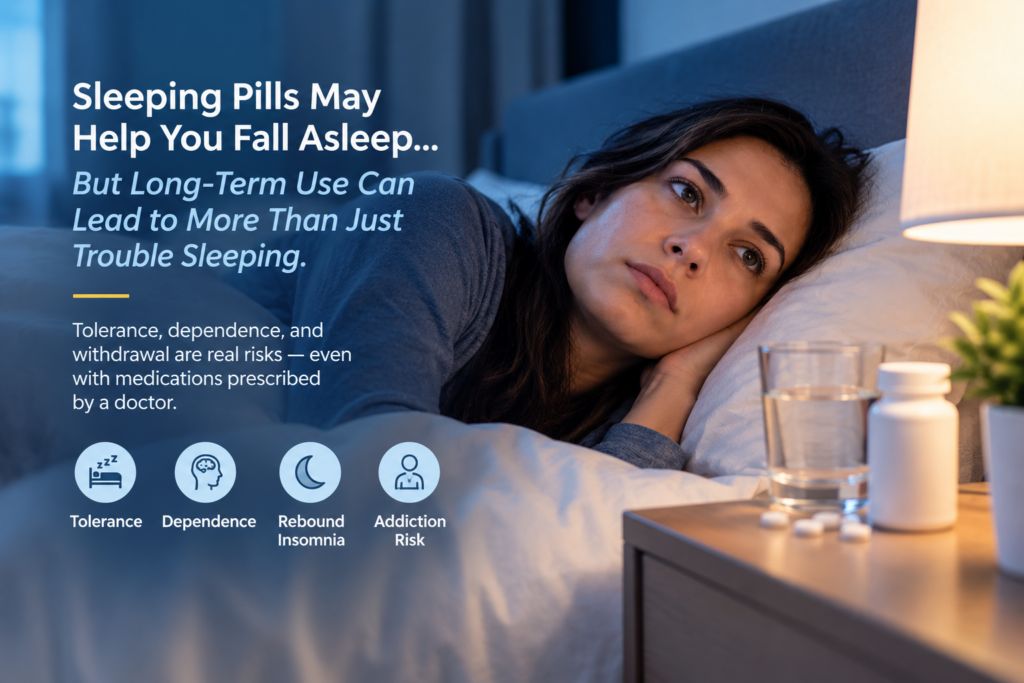
Sleeping pills lose effectiveness because the brain adapts to the medication and builds tolerance, so the original dose stops producing the same effect. This is often the first sign of a developing problem.
Tolerance tends to progress in a fairly predictable order:
- The usual dose takes longer to work
- Sleep starts feeling lighter or more broken
- A second pill, or a higher dose, gets added without a doctor’s input
- Skipping a dose causes real anxiety about sleep
- Stopping causes physical withdrawal symptoms
That fourth and fifth stage is usually where sleeping pill dependence becomes obvious, even to the person going through it.
What Is Rebound Insomnia?
Rebound insomnia is a temporary but often severe worsening of sleep problems that follows stopping a sleep medication, sometimes worse than the original insomnia ever was. It is one of the main reasons people feel stuck taking a pill every night.
It matters for a few reasons:
- It tricks people into believing the medication is still working
- It makes quitting feel impossible without medical guidance
- It’s frequently mistaken for the insomnia getting worse, when it’s actually withdrawal
Rebound insomnia is a documented withdrawal pattern, not a sign of personal weakness, which is exactly why a supervised taper matters.
What Are the Warning Signs of Sleeping Pill Addiction?
Warning signs usually build gradually through a mix of behavioral and physical changes rather than appearing all at once. Catching them early makes treatment considerably more manageable.
| Category | Warning Signs |
| Behavioral | Taking extra doses, running out early, seeking refills from multiple doctors |
| Physical | Daytime grogginess, memory gaps, slower reaction time |
| Psychological | Anxiety about sleeping without the pill, minimizing how often it’s used |
| Social | Hiding pill use from family, skipping plans due to fatigue |
Three or more of these showing up together is a reasonable point to have an honest conversation with a treatment professional.
Recognize some of these patterns in yourself or someone you love? Call (800) 410-6552 or start the admissions process today.
How Does Long-Term Sleeping Pill Use Affect the Body?
Long-term use affects far more than sleep. It can touch memory, coordination, and in some cases breathing, particularly when combined with alcohol or opioids. Risk generally climbs with age.
Documented effects include:
- Higher fall risk in older adults tied to next-day drowsiness
- Memory and concentration issues that can linger even with continued use
- Slowed breathing when mixed with other central nervous system depressants
- Rebound anxiety that outlasts the original sleep problem
Not everyone who takes a sleep aid develops an addiction. The risk simply climbs the longer nightly use continues without medical oversight.
How Is Dependence Different From Addiction?
Dependence is the body’s physical adaptation to a medication. Addiction adds a compulsive behavioral pattern, meaning use continues despite clear negative consequences. The two frequently overlap but are not the same thing.
| Factor | Dependence | Addiction |
| Physical withdrawal | Present | Often present |
| Compulsive use | Not necessarily | Usually present |
| Impact on daily life | May be minimal | Typically significant |
| Treatment approach | Medical taper | Taper plus behavioral therapy |
A person can be physically dependent without meeting the criteria for addiction. Either situation still calls for medical supervision when stopping.
What Does Treatment for Sleeping Pill Addiction Look Like?
Treatment usually starts with a medically supervised detox, since stopping sedatives abruptly can trigger serious withdrawal, including seizures in some cases. This step should never be attempted alone.
A typical treatment timeline looks like this:
- Days 1 to 7: Medical detox with a gradual, closely monitored taper
- Weeks 2 to 4: Individual therapy addressing the root causes behind the insomnia and the medication reliance
- Weeks 4 to 8: Group therapy, life skills work, and non-medication sleep strategies
- Beyond 8 weeks: Aftercare planning, alumni support, relapse prevention
At Southern California Recovery Centers, our prescription pill addiction treatment program is built around each client rather than a fixed script, with our own in-house clinical team overseeing every stage.
A Common Scenario We See
A client in his thirties came to us after four years on prescription sleep medication, started after a difficult divorce. By the time he reached out, he was taking nearly double his original dose and hadn’t slept without it in years.
Detox revealed something he hadn’t expected. Once the medication cleared his system and his sleep cycle reset over several weeks, his sleep actually improved. The pill hadn’t fixed his insomnia. It had been masking it, and slowly making it worse.
What About Insurance and Cost?
Cost is one of the biggest hesitations people have before reaching out, and it’s a fair one. Southern California Recovery Centers works directly with major insurance providers, including Aetna, Cigna, and UHC, to cover as much of treatment as possible.
Our admissions staff acts as a liaison with your insurance company, so you’re not navigating that process alone. You can verify your insurance online in a few minutes, before committing to anything.
Getting Help in Southern California
Southern California Recovery Centers operates facilities in Carlsbad and Cardiff-by-the-Sea, serving clients throughout San Diego County and the broader Southern California region. Families searching for treatment near Carlsbad, Oceanside, or Encinitas regularly find their way to our program.
We work with clients from across the country, but our roots and our facilities are firmly in Southern California, where the ocean setting is part of the recovery environment itself.
Ready to Talk Through Your Options?
You don’t need to have it all figured out before calling. A conversation with our admissions team costs nothing and commits you to nothing.
Call (800) 410-6552 or reach out through our contact page to start a completely confidential conversation.
This content is for informational purposes and does not replace individualized medical advice. If you are experiencing withdrawal symptoms or a medical emergency, contact 911 or seek immediate medical attentio
Frequently Asked Questions